

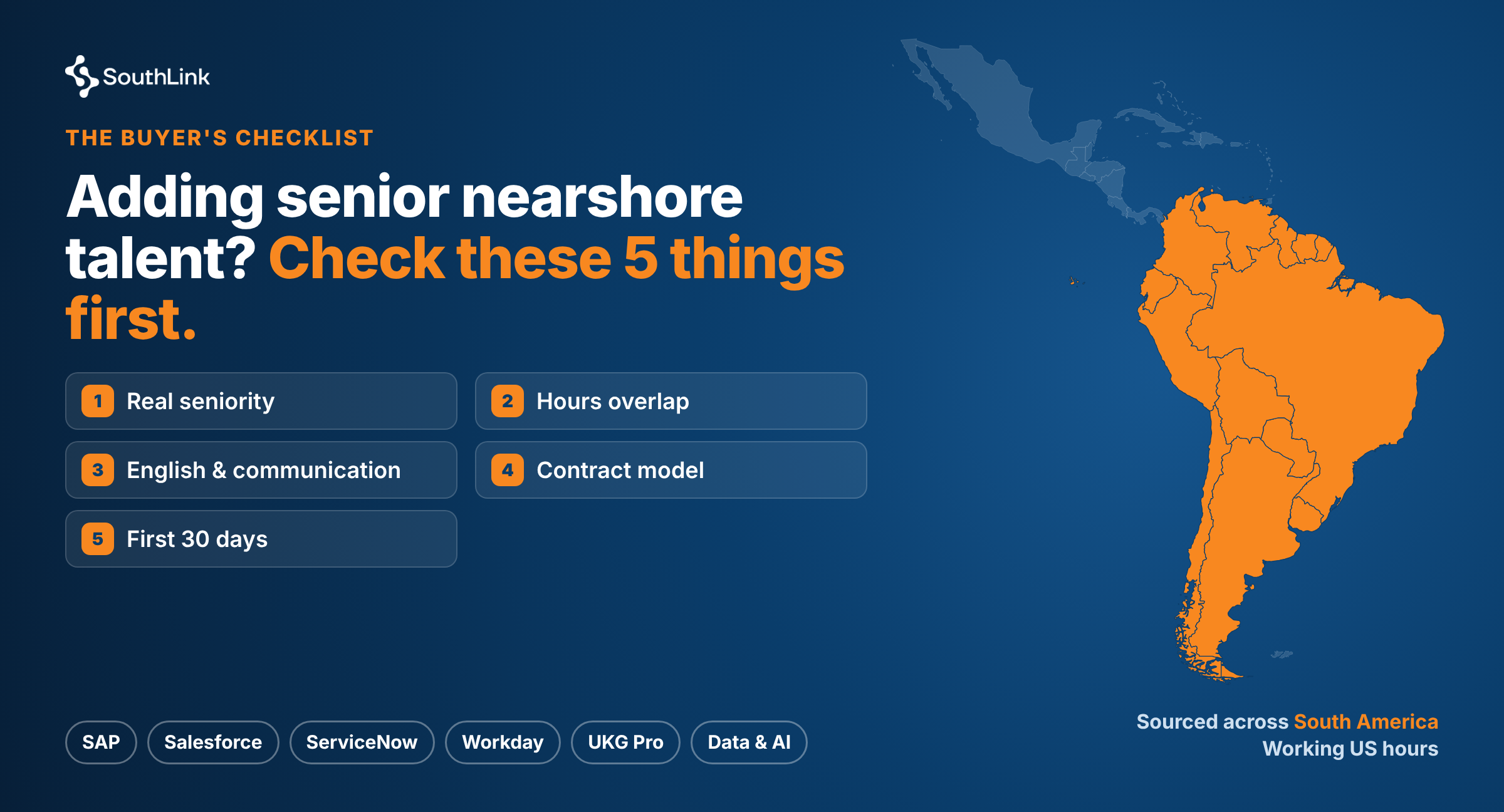
Most US teams don't go looking for nearshore talent because it's a trend. They go looking because a project is signed, a key person just left, or the backlog of Data and AI engineering work keeps growing faster than they can hire. Senior resources in SAP, Salesforce, ServiceNow, Workday, UKG Pro, Data Science and AI Engineering are hard to find in the US and harder to keep, and offshore teams twelve hours away often trade lower rates (and lower quality) for slower everything.
Latin America has become a serious option for US and European companies that need senior specialists working alongside their own team. But "nearshore" is a broad label, and the results depend on the questions you ask before anyone starts. Here's a practical checklist to work through before you add anyone.
1. Verify real seniority, not years on a résumé
Years of experience are easy to list and hard to judge. Seniority shows up in what someone has owned and decided, not in how long they've been around a platform.
- Ask about decisions, not tasks. A senior SAP consultant should be able to explain why a migration was sequenced the way it was. A senior Salesforce architect should be able to explain why one design was chosen over another. A senior data scientist should be able to explain why a model stayed out of production. A senior AI engineer should be able to explain how much value you’re extracting from the implementation of agents in your environment.
- Ask for the messy project. Have candidates walk you through an implementation that went sideways and what they did about it. Seniority is clearest when things break.
- Test the way the work is really done. Skip the trivia. Use a short scenario from your own environment, such as a ServiceNow workflow that needs redesigning, a Workday integration that keeps failing, or a data pipeline that has to be production-ready. Watch how the candidate asks questions before answering.
- Check certifications, but don't stop there. Platform certifications show baseline knowledge. They don't show judgment.
- Interview the person who will do the work. Make sure the specialist you meet is the one who joins your team.
2. Working-hours overlap matters more than location
"Nearshore" is often sold on geography. What actually changes your day is the overlap in working hours.
If your specialist is online during your working day, questions get answered in the same meeting instead of the next morning. A standup includes everyone, and a blocker raised at 11 AM is cleared by lunch. On a platform rollout or a production issue, that difference adds up every single day.
Before you commit, confirm:
- Which hours the person will actually work, written down, not just "US-friendly."
- How much of that time overlaps with your core collaboration window, including your West Coast stakeholders if you have them.
- How daylight saving changes affect the gap. Most South American countries don't change their clocks, so the gap with US time zones shifts during the year. Depending on the country and the season, talent across South America is anywhere from one hour behind to two hours ahead of US Eastern, which keeps most of the working day shared.
- What happens during urgent incidents and who covers them.
3. Set clear communication and English expectations
Strong technical skills don't help much if the communication around them is hard work. Decide what "good" looks like for your team before interviews start.
- Match English level to the role. A specialist who talks directly to business stakeholders, runs workshops or presents to leadership needs different fluency than one doing focused build work with a technical lead.
- Assess it in the interview, live. A conversation about a real problem tells you more than any test score.
- Agree on the communication norms: response times, which channels to use, how status gets reported, and when to call instead of type.
- Look for people who push back. Senior specialists should tell you when a requirement doesn't make sense. Ask candidates for an example of when they disagreed with a client and how they handled it.
4. Choose the contract model that fits the work
How you engage senior talent should follow from the work, not the other way around. There are three common models.
- Dedicated specialist. One or more people join your team full-time for an ongoing period. This fits sustained roadmaps, platform ownership, long-running data and AI programs, and backfilling a role while you hire.
- Project-based. A defined scope with a defined end, such as a Workday module rollout, a UKG Pro configuration or a Salesforce integration. This fits when you know the outcome you need and when it has to be done.
- Contract-to-hire. You start on contract, with the option to bring the person on directly later. This fits when you want to confirm the fit in real work before making a long-term commitment.
Whichever model you choose, make sure you understand how replacements work if the fit isn't right, what the notice terms are, and who owns the intellectual property and the documentation.
5. Plan a good first 30 days
A senior hire who isn't onboarded well looks like a junior one for a month. A short, deliberate onboarding plan protects your investment.
- Before day one: have access, accounts, environments and documentation ready. A specialist waiting a week for system access is a week lost.
- Week 1: introductions to the people they'll work with, a walkthrough of the architecture and current state, and one small, real task to complete.
- Weeks 2–3: ownership of a defined piece of work, regular check-ins with a named point of contact on your side, and early feedback in both directions.
- Week 4: a short review covering what's working, what's blocked, and what they should own next.
Treat nearshore specialists as part of your team, not as an outside vendor. Put them in the same channels and the same meetings and give them the same context, and they'll perform like it.
The short version
Before you add senior nearshore talent, check five things:
- Seniority shown in real decisions, not just years.
- Working-hours overlap, confirmed in writing.
- Communication and English expectations that match the role.
- A contract model that fits the work.
- A 30-day onboarding plan that's ready before day one.
SouthLink connects US teams with senior technical talent from Latin America across SAP, Salesforce, ServiceNow, Workday, UKG Pro, Data Science and AI Engineering, sourced across South America and working your hours. If you're weighing whether nearshore talent fits your team, we're happy to talk it through.